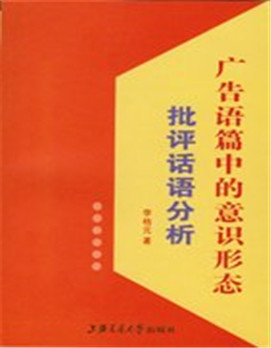
廣告語篇中的意識形態(tài)研究--批評話語分析
作者:李桔元
字?jǐn)?shù):214
頁數(shù):214
版次:
定價(jià):25
ISBN:978-7-313-05958-1
出版日期:2009/11
圖書簡介
《廣告語篇中的意識形態(tài):批評話語分析》是語言學(xué)領(lǐng)域內(nèi)有關(guān)批評話語分析的專著���,也是第一本對廣告語篇系統(tǒng)進(jìn)行批評性研究的著作�。批評話語分析是近年來國外發(fā)展迅速、國內(nèi)正在興起的一門關(guān)于語篇分析的理論與實(shí)踐的學(xué)科�?����!稄V告語篇中的意識形態(tài):批評話語分析》從理論上進(jìn)一步厘清了批評話語分析的幾個(gè)核心概念和結(jié)構(gòu)體系�����,從實(shí)踐上對作為公共語篇的廣告語篇進(jìn)行了較為系統(tǒng)的批評性分析�����,這在批評話語分析的具體應(yīng)用上作出了有益的探索���。
圖書目錄
Acknowledgements
前言
List of Figures and Tables
Chapter One Introduction
1.1 Background of studies of advertising language
1.2 Research questions and significance of this study
1.3 Theoretical and methodological orientations of this study
1.4 Data collection
1.5 Organization of the dissertation
Chapter Two Theory Preliminaries
2.1 Introduction
2.2 Critical discourse analysis
2.2.1 From discourse analysis to critical discourse analysis
2.2.2 A survey of critical discourse analysis
2.3 The view of discourse in critical discourse analysis
2.3.1 Discourse vs. Text
2.3.2 Discourse as action
2.3.3 Discourse as ideologies
2.4 Ideology and power in language
2.4.1 Ideology
2.4.2 Power
2.4.3 The relationship among language�����, ideology and power
2.5 The text-oriented framework for analysing ideologies
2.5.1 Hallidayan paradigm : text functionality in context
2.5.2 Framework for analysing ideology in discourse: Fairclough s three-dimension model
2.6 Summary
Chapter Three Modality as Explicit Representation of Ideologies in Advertising Discourse
3.1 Introduction
3.2 The ideological nature of modality
3.3 Meaning dimensions and grammatical devices of modality
3.3.1 Meaning dimensions of modality
3.3.2 Grammatical devices of modality
3.4 Modality and its ideological meanings in advertising discourse
3.4.1 Ideological meanings of modality in advertising discourse: a case study
3.4.2 Modality distribution in advertising texts: empirical studies
3.5 Summary
Chapter Four Personal system as Representation of
Ideologies in Advertising Discourse
4.1 Introduction
4.2 The functions of personal pronouns:SFL perspective
4.3 The politics of some personal pronouns
4.3.1 "them and us" attitude
4.3.2 "me" and "you" :subjectivity or empathy
4.4 Ideological meanings of personal pronotms in ads
4.4.1 Characteristics of use of personal pronouns in ads
4.4.2 Personal pronouns work ideologically in building relations
4.5 Snmmary
Chapter Five Transitivity as Implicit Representation of Ideologies m Advertising Discourse
5.1 Introduction
5.2 Transitivity as the construal of experience
5.3 Transitivity as representation of ideologies
5.4 Transitivity system and the power relations in advertising discourse
5.5 Summary
Chapter Six Intertextnality as Representation of Ideologies in Advertising Discourse
6.1 Introduction
6.2 What is intertextuality
6.2.1 Bakhtin:dialogism and heteroglossia
6.2.2 Kristeva:intertextuality as dialogue between texts or text and social context
6.2.3 Other interpretations of the term "intertextuality"
6.2.4 Intertextuality and interdiscursivity
6.3 The ideological functions of intertextuality
6.4 Intertextuality as hegemonic struggle in advertising discourse
6.5 Summary
Chapter Seven Conclusion
7.1 Summary of this dissertation
7.2 Major findings
7.3 Limitations of this study
7.4 Suggestions for further research
Appendices
Bibliography









 在線留言
在線留言


 loading......